

What Was The Ethnic Makeup Of Montana In The 1900's
1805
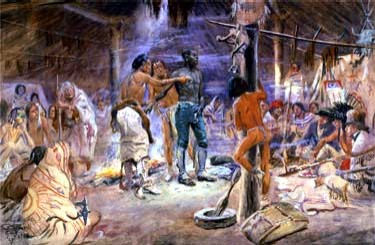
African American slave York entered Montana as a office of the Lewis and Clark expedition. ( Montana Newspaper Association Inserts, January eighteen, 1929)
1807
Manuel Lisa began Montana's fur trade era by constructing a fort at the confluence of the Yellowstone and Big Horn rivers.
Edward Rose, who later lived for several years amongst the Crows, served on Lisa's expedition. Several other African Americans somewhen worked in the fur trade in Montana before the manufacture came to an stop by the 1840s. (Kenneth Wiggins Porter, "Negroes and the Fur Trade," Minnesota History, Dec 1934, 424-433; Willis Blenkinsop, "Edward Rose," equally institute in Leroy R. Hafen, ed., The Mountain Men and the Fur Merchandise of the Far West, 5. 9, pp. 335-345)
1825
Jim Beckwourth first entered Montana equally a member of William Ashley's 3rd western expedition. Reputedly born in Virginia of a slave mother and white overseer, Beckwourth became legendary every bit a mountain man, spending fourth dimension in Montana, Colorado, New Mexico, Utah, and California. He gave a detailed—and exaggerated—business relationship of his life which was published as Life and Adventures of Jim Beckwourth (1856). He died near Ft. C.F. Smith in 1866, working every bit a mediator between the U.S. Army and a group of Crow Indians. (Delmont R. Oswald, "James P. Beckwourth," equally constitute in Leroy R. Hafen, ed., The Mountain Men and the Fur Trade of the Far West, v. Half-dozen, 37-lx)
1832
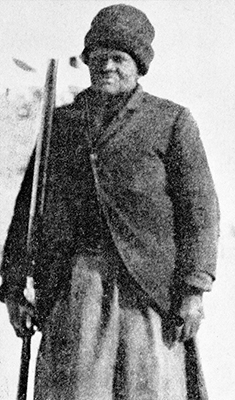
Mary Fields was born in Tennessee. She moved to Montana in 1884, where she worked at St. Peter's Mission about Peachy Falls. She worked at the school until a falling out with the Catholic assistants led to her ouster in 1895. She and then moved to Pour and found work equally a mail omnibus driver for the U.S. Post, leading to her nickname "Stagecoach Mary." Fields passed abroad in 1914 and is buried in Cascade's Hillside Cemetery. (Mary Fields, vertical files, MHS)
1837-1840
Smallpox epidemic killed many Montana Indians.
1841
Father DeSmet built St. Mary's Mission near present-mean solar day Stevensville.
1846
American Fur Co. built Ft. Benton on the Upper Missouri River deep in Blackfeet country.
c. 1858
Charles "Smoky" Wilson was built-in in St. Louis, Missouri. Wilson came to Montana in the late 1860s, travelling as far as the Bozeman area. He worked for Nelson Story equally a horse wrangler until he constitute work equally an interpreter for the U.S. Regular army, after having learned the Crow language. One of his claims to fame was that he helped bury the remains of the 7th Cavalry soldiers killed at the Battle of the Picayune Big Horn. After several years equally an interpreter, Wilson worked at the Crow reservation, performing such tasks as mailman, interpreter, and policeman. Somewhen he was adopted past the Crows, and allowed a total share of benefits and country. 1 source claims he was married several times, to both Native American and African American women. At the time of his decease in 1936, he was survived by a son, John East. Wilson. ( Hardin Tribune-Herald, "Colorful Career of 'Smoky' Is at an Cease," July 24, 1936; Charles Wilson, vertical file, MHS).
1862
U.S. Congress passed the Homestead Act. Along with whites, African Americans used this and afterward country legislation to obtain homesteads in Montana.
While reports of aureate strikes in the Deer Lodge Valley and Gold Creek came from what would go Montana Territory as early as the 1850s, the 1862 strike at Grasshopper Creek and the rise of Bannack, and subsequent strikes at Alder Gulch (Virginia Urban center, 1863), and Last Chance Gulch (Helena 1864), triggered the Montana gilded blitz.
1863
The Emancipation Proclamation freed forever "...all persons held as slaves within any State or designated function of a State the people whereof shall then be in rebellion against the United states of america."
1864
Montana Territory created.
1865
Civil State of war ended.
Thirteenth Amendment passed, abolishing slavery.
1866
Samuel Lewis arrived in Montana. Born in Republic of haiti, Lewis was a well-respected barber and residential developer in Bozeman, where he owned several charming rental backdrop. He died a prosperous man in 1896; his Bozeman residence is listed in the National Register of Historic Places. (Samuel W. Lewis, vertical files, MHS.)
Congress authorized the creation of six all-African American regiments. Afterward dubbed "Buffalo Soldiers," elements of these units served in Montana, most notably at Forts Missoula, Assiniboine, Harrison, Shaw, Custer, and Keogh. (Afro-Americans-Military, vertical file, MHS; AGO General Order No. 56, Aug. ane, 1866, and AGO Full general Order No. 92, Nov. 23, 1866; Robert 1000. Utley, Frontier Regulars: The Us Regular army and the Indian, 1866 – 1891 (1973), p. 12.)
1867
"An Irish Democrat named Lynch" murdered black Helena resident Sammy Hays during a postal service-election riot. ( Helena Weekly Herald, September v, 1867, and Helena Daily Herald September 3, 1869.)
1870
The Census listed 183 African Americans in Montana Territory out of a full population of 20,595.
1872
The Territorial Legislature voted to segregate African American children in schools. The constabulary was overturned in 1883. (J.Due west. Smurr, "Jim Crow Out West," J.W. Smurr and K. Ross Toole, eds., Historical Essays on Montana and the Northwest , pp. 149-203.)
1873
E.T. Johnson elected mayor of the unincorporated metropolis of Helena on May 22, 1873. ( Helena Weekly Herald, May 22, 1873 (p. seven)) This is probable Edward T. Johnson, a Helena resident since at least 1868, who in the 1870 census is identified as a 32-year-quondam barber from Washington D.C. with a personal estate worth $g. The 1868 Helena Urban center Directory listed him every bit E.T. Johnston, born in D.C., working equally a barber and residing on Chief Street.
1876
African American Isaiah Dorman, an interpreter for the United States Army, died at the Boxing of the Little Large Horn. (Robert J. Ege, "Braves of All Colors: The Story of Isaiah Dorman, Killed at the Footling Big Horn," Montana: the Magazine of Western History , January 1966, pp. 35-40; Roland C. McConnell, " Isaiah Dorman and the Custer Expedition ," Journal of Negro History, July 1948, pp. 344-352.)
1879
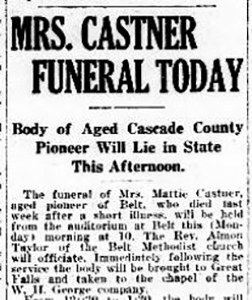
Mattie Bost, African American, married white John Castner. Together they built the first cabin in Belt, which somewhen evolved into a hotel, restaurant, and stage station that Mattie ran while John built upward mining and real estate holdings. She later on operated a cattle ranch in the Highwood Mountains, and was well thought of because of her generosity. When Mattie passed away in 1920, her estate was worth $25,000. ( Great Falls Daily Tribune, April 5 and 7, 1920; Ethel Castner Kennedy and Eva Lesell Stober, Belt Valley History, 1877-1979, pp. 21-22; Mattie Bost Castner, vertical file, MHS.)
1880
U.S. Census constitute 346 African Americans in Montana out of a population of 39,159.
1881
William Woodcock, a U.Due south. Align'due south servant, sued a Butte eating place under the 1875 Civil Rights Human action after he reported its proprietor asked him to leave. In 1883, the courtroom ruled in his favor and awarded him the minimum settlement of $500. (Smurr, "Jim Crow Out Westward," 173–175; "The 2 Colors of the Chop House Affair," The Weekly Miner, December 20, 1881, p. five; "Montana News," The Daily Enterprise, December x 1883, p. 4 .)
1882
Anaconda Mine in Butte discovered to take richest vein of copper in the earth.
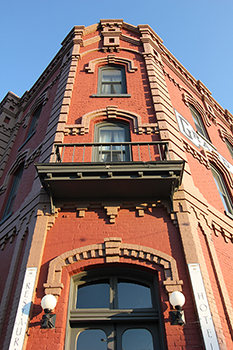
Silvery Bow Guild founded in Butte. Like the Montana Order in Helena, African Americans often made up a significant part of the staff. ( Butte Daily Miner, Special Edition, January ane, 1886) Grand Marriage Hotel opened in Fort Benton. Its 11-person staff included 9 African Americans. (Ken Robison, "The Jewel in Fort Benton's Crown: The Grand Union," Fort Benton River Press Grand Union Edition, November ii, 2007.)
1883
A "golden spike" ceremony on September viii at Gilt Creek, Montana celebrated the completion of the Northern Pacific Railway. Railroad companies beyond the nation provided steady employment for many African American men, mainly as " Pullman porters."
Many members of northern Montana tribes died during Starvation Winter.
Copper boom began in Butte.
1884
Helena businessmen founded the Montana Social club in Helena. Several African Americans have worked for this exclusive organisation. The most famous was Julian Anderson, who served drinks at the Order from 1893-1953. (" The Montana Club, Helena, Montana," MHS; Julian Anderson vertical file, MHS, has a drove of his drinkable recipes.)
1886
Helena's African American customs convened their annual Emancipation Day commemoration on August ii, to commemorate the cease of slavery in British colonies, which took effect on August 1, 1834. Stockman Dan Floweree donated $50.00 to assistance encompass expenses for the celebration, and Mayor Theodore H. Kleinschmidt and several other white residents attended. ( Helena Herald, August 3, 1886; Helena Independent, Baronial 3, 1886.)
1887
Later making a mark as an abolitionist, daguerrotypist, and entrepreneur in Cincinnati and Minneapolis, James Presley (J.P.) Ball Sr. moved to Helena. He immediately became a noted leader among the city's African Americans. Amongst other pursuits, he was active in the Republican Party (he was elected to serve on the Republican Party Central Committee for Lewis and Clark County in 1894), and served equally president for Helena'south Afro-American Guild. At his J.P. Ball & Son studio he took many images of white and black Helena residents and events, including the laying of the cornerstone of the Land Capitol building. He moved to Seattle in 1901, eventually dying in Hawaii in 1905. His photographs provide deep insight into of plow-of-the-century Helena. Examples of his work tin be viewed at an online exhibit at the Cincinnati Historical Society. (James P. Ball, vertical files, MHS; The Colored Denizen, May 10, 1894; Deborah Willis, ed., J.P. Ball, Daguerrean and Studio Photographer, fourteen-xix)
1888
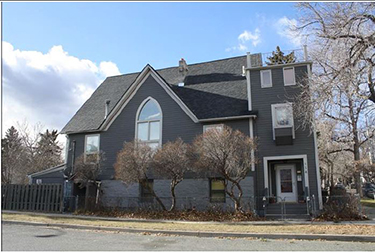
The Helena blackness community founded the St. James African Methodist Episcopal Church. The center of social life for many African Americans, it connected as a congregation through the 1940s. ( Helena Weekly Herald, September 27, 1888, p. 7; Helena, MT—Churches—African Methodist Episcopal Church vertical file, MHS.)
1889
Montana became the 41 st state .
1890
The census reported 142,924 people in Montana, including 1,490 identified every bit African American.
The internationally-acclaimed Fisk University'south Jubilee Singers performed a series of shows beyond the state in early May 1890, benefitting several churches. Stops included Helena, Livingston, Deer Lodge, Boulder, and Anaconda. ( Helena Contained, May 15, 1890; Anaconda Standard , May vi, 1890.)
1891
Its congregation began structure of the first Union Bethel African Methodist Episcopal (AME) Church building in Keen Falls. A 2nd church building replaced the original in 1917. The church represents patterns of black community growth in the western U.S., and is closely tied to the historical evolution of the African American customs in Great Falls. In 2003 it was listed in the National Annals of Historic Places.
1893
The Panic of 1893 devastated the country's silver mining industry. Nearly ane-third of Montanans lost their jobs every bit banks failed and mines closed.
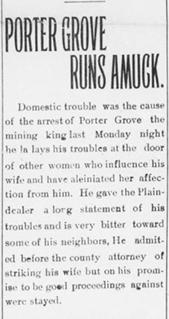
The Montana and Illinois Gold Mining Visitor incorporated to develop claims in the Townsend area. The owner, Charles Porter Grove, traveled the eastern United States to attract capital from African American investors. Unfortunately, the mines never made any money. Grove began to exhibit erratic behavior, and in 1911 froze to expiry in a gulch virtually Radersburg. Later, more than successful African American concerns in Montana included the Afro-American Mining and Milling Visitor (incorporated in 1906, with properties about Butte) and the Bernice-Red Rock Mining Company (founded in 1908, with belongings in Jefferson County almost Bernice). (Certificate of Incorporation of Montana and Illinois Gold Mining Company, Baronial 5, 1893, S2007-03, Montana Secretarial assistant of State, Business Services Bureau Records, ID# D002152; Helena Contained, Feb 23, 1894, p. 5; Montana Plaindealer, April 12, 1907, p. 1; Helena Daily Contained, January 7, 1911.)
African American Emma Wall and her white husband John Orr married in Glendive. On their wedding nighttime they were forcibly "alabastined" and "ebonized" past a mob, and given 24-hour find to get out boondocks. ( Glendive Contained, June 1893 and Kansas Urban center Gazette, May 2, 1895. Montana Historical Society Clippings file: Glendive early June 1893.)
U.S. District Estimate Hiram Knowles appointed Libby resident and Montana's offset black attorney, John D. Posten, U.S. Commissioner to the Commune Court.
1894
Montana'due south first black newspaper, The Colored Citizen , was published in Helena from September 3 to December xv, 1894, importantly to advance the city's case for designation equally the state uppercase.
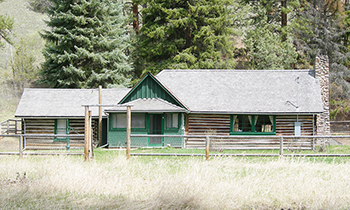
Former slave Annie Morgan settled on an abandoned play tricks subcontract near Philipsburg. In 1913, she filed a homestead entry for the property she shared with her white common-law husband, Joseph "Fisher Jack" Instance. The Morgan-Instance Homestead was listed in the National Annals of Historic Places in 2005.
1896
Butte's black residents established the Afro-American Club of Butte City as a social outlet to pursue interests in music, literature, and science. Anacondans founded the A.J. Campbell Afro American Social club in their metropolis two years later. ( Anaconda Standard, October 4, 1898, p. iii. )
Lewis and Clark Canton officials hung William Biggerstaff for the murder of boxer Richard Johnson in Helena. ( Anaconda Standard, June 10, 1895, p. 7 ; Anaconda Standard, April 5, 1896, p. 5 ; Great Falls Weekly Tribune, April x, 1896, p. 2 . Also meet MHS Inquiry Center Photo Archives images #957-610, #957-611, #957-612; and #957-613.)
1897
Soldiers from the Twenty-5th Infantry stationed at Fort Missoula rode bicycles from Missoula to St. Louis, Missouri—approximately 1,900 miles—in forty days. (U.s. Army Twenty-fifth Infantry Regiment, vertical files, MHS.)
1900
1,523 African Americans listed in census for Montana (243,329 total population).
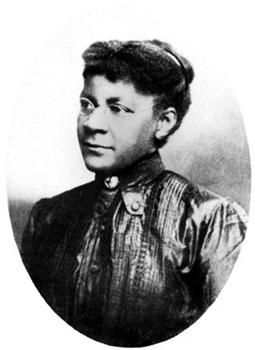
African American Sarah Gammon (Brownish) Bickford became owner of the Virginia City Water Visitor upon the death of her married man Stephen. She ran the utility until her death in 1931. ( Madisonian, March 22, 1900, July 24, 1931; Madison County History Clan, comp., Pioneer Trails and Trials: Madison County, 1863-1920, pp. 305-306 .)
1901
An African Methodist Episcopal Church building congregation organized in Billings, coming together at 302 North 24 th Street. The church building building, chosen Wayman Chapel, moved to the south side in 1916 and served the customs until 2013. The congregation continues to be an active part of the Billings community.
In June, congregants laid the cornerstone for Shaffer'south Chapel African Methodist Episcopal Church on the southeast corner of Idaho and Platinum Streets in Butte. ( Anaconda Standard, June 9, 1901.)
According to the Butte City Directory, Bethel Baptist Church, a black congregation, organized in Butte in July 1901. It after moved its church building to 217 West Mercury, the site of the original AME church.
1902
The New Age, published from May 30, 1902, to February 1903 , represented the interests of the black residents of Butte, Montana. In the countdown edition the editors, John W. Duncan and Chris Dorsey, alleged their intention to institute a statewide network of reporters dedicated to bringing the news of the African American community throughout Montana to readers in Butte.
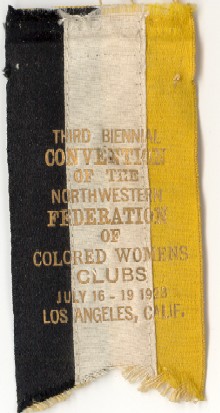
The Afro-American Women'south Social club was founded in Butte, perhaps the beginning blackness women'south organization in Montana. Though soon forced to disband, it re-emerged as the Pearl Guild in 1918 to aid support the American cause during Globe War I, and became instrumental in creating the Montana Federation of Negro Women'south Clubs. Other black women's clubs included the Phyllis Wheatley Club (Billings), the Dunbar Art and Written report Club (Great Falls), and the Pleasant Hour Guild (Helena). (Montana Federation of Colored Women's Clubs, Montana Federation of Colored Women'southward Clubs records, 1921-1978, MC 281, MHS.)
Vaudeville stars Bert Williams and George Walker gave three performances at Sutton's New G in Butte. Williams was the most pop African American entertainer of his era, highly regarded for his singing, dancing, comedy, and composing. A reporter from Butte's blackness newspaper, The New Age, noted "A (corking) many attended the 3 performances. This is evidently the best colored play that has all the same played a phase in Butte." Members of Butte'southward African American customs gave a dinner in their laurels. ( The New Age, May xxx, 1902, p. 4.)
1903
In June 1903, members of Anaconda's Allen Chapel AME church laid the cornerstone and moved an abandoned schoolhouse edifice donated by the Anaconda Company to the urban center's downtown to serve as a permanent habitation. ( Anaconda Standard, June eight, 1903, p. 3.)
In May, President Theodore Roosevelt visited Montana, and African Americans in Montana gave speeches and gifts in honor of his visit; in Helena Roosevelt received an ebony and silver trowel to "continue to spread the cement of human kindness to all mankind", while in Butte he was given a pair of scales because it was given past citizens who had "weighed his every act" and that Roosevelt had been "so evenly counterbalanced in the calibration of justice". His Butte appearance also featured a spoken communication past C.F. Jones, who represented African Americans in the city. ( Helena Daily Independent, May 28, 1903; Anaconda Standard, May 28, 1903.)
1906
African American Joseph B. Bass began publishing the Montana Plaindealer in Helena, which ran from Mar. 16, 1906 to Sept. viii, 1911. The editors supported the Republican Party. Other black-owned newspapers were The Colored Citizen (which began and concluded in Helena in 1894, and existed mainly to support Helena in the majuscule fight) and The New Age (published in Butte from 1902-1903). (Montana'southward African American Heritage Resources website, Newspapers page; Rex C. Myers, "Montana's Negro Newspapers," Montana Journalism Review sixteen, 1973, pp. 17-22.)
1909
National Association for the Advancement of Colored People was founded in New York Urban center.
Congress Passed the Enlarged Homestead Act .
The Montana legislature passed a law making marriage between whites and non-whites illegal. The Montana Legislature repealed the police force in 1953. ( Montana Plaindealer, February 12, 1909, p. 1; Loralee Davenport, "A Journey toward Sovereignty and Security: The African American Community of Butte, Montana from 1885-1955," on file at the Butte-Silver Bow Public Archives, 2001, p. 72.)
Black citizens in Helena commemorated the 100 th ceremony of Abraham Lincoln's nascency. Lincoln'due south birthday was celebrated annually by Montana's African American communities. ( Montana Plaindealer, Feb 12, 1909, p. 1.)
1910
The Demography listed one,834 African Americans in Montana (out of a full population of 376,053).
The black parishioners of Helena'due south Second Baptist Church building (Ebenezer Mission) received blueprints for their new church edifice to be located at 1260 Harrison Avenue. Mrs. Mamie Bridgwater served every bit an active fellow member of the church building, which often met in her dwelling house prior to the church building's construction. ( Montana Plaindealer , October 21, 1910, p. 4. )
1911
Butte'due south Socialist Mayor Lewis J. Duncan appointed African American Frank Cassels as metropolis policeman. Not long after, the Butte City Council rejected his appointment, as well as four other police officers. ( Daily Missoulian, September 13, 1911, p. 1.)
1912
Last Run a risk Gild organized in Helena "for the social comeback amongst its members, literary and dramatic entertainments, and benevolent work among those in need of assistance."
1913
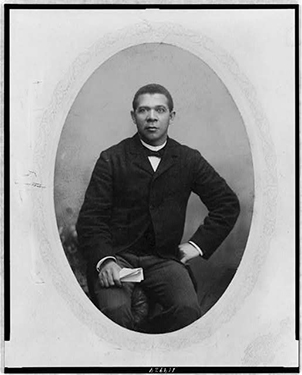
Booker T. Washington lectured in Billings, Bozeman, Butte, and Helena (where he was introduced by Governor Samuel V. Stewart) on black and white relations in the United States. Washington called for adaptation betwixt the races: "I believe at that place is room enough, justice plenty, and good sense plenty to enable the two races to live here side by side and work out their ain destinies." Blacks and whites together attended his lectures in the state, and he was hosted by members of black and white organizations in each town. ( Billings Daily Gazette, March 4-five, 1913; Bozeman Daily Chronicle, March 4, 6-seven, 1913; Anaconda Standard, March 6-7, 1913; Butte Miner, March half dozen-7, 1913; Helena Daily Independent, March 8, 1913.)
On April 4, 1913, a mob in Mondak lynched African American construction camp worker J. C. Collins for killing Sheridan County Sheriff Thomas Courtney and Deputy Sheriff Richard Burmeister. Newspapers reported that Collins killed them when they attempted to auscultate him for assaulting the wife of a swain camp worker.( Wibaux Pioneer, April 18, 1913, p. 2; Yellowstone Monitor, April 10, 1913, p. 1 ; Poplar Standard, Apr 10, 1913; Culbertson Searchlight, April 11, 1913; MHS Photograph Athenaeum, PAc 75-78.37 and PAc 75-78.38.)
1914
On Nov 3, 1914, Montana men voted 53 to 47 percent in favor of equal suffrage. That year Montana (and Nevada, which likewise passed a suffrage amendment in 1914) joined 9 other western states in extending voting rights to non-Native women. (Indian women would accept to wait until passage of the 1924 Indian Citizenship Human action to gain admission to the ballot.)
Earth State of war I began.
1916
The controversial pic Birth of a Nation played in Montana theaters, and protests against its depictions of African Americans were held in Helena and Butte. ( Anaconda Standard, January 26, 1916; Helena Independent , February 22 and 25, 1916.)
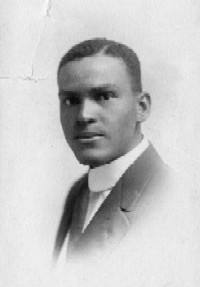
Arthur C. Ford of Helena graduated with a degree in mechanical engineering from Montana Country College (now Montana State University), making him one of the start black graduates of that school. Ford was later named president of New York City'southward Department of H2o Supply, Gas, and Electricity, thus becoming the commencement African American to be appointed commissioner of a New York city agency. Ford passed abroad in 1985 at the age of 93. His father Nathianel had been a coachman for Montana Senator T.C. Power. ( Helena Independent, May 31, 1916; New York Times, April 17, 1985; Groovy Falls Tribune June xix, 1950, as institute in MC 55, C.B. Power Papers, box 8, folder nine, MHS; Helena Independent Record, February ii, 1953.)
1917
Years of drought began in Montana that ended homesteading boom.
3 black railroad workers- Leslie Fahley (or Foley), Harrison Gibson, and Henry Hall -were hanged in White Sulphur Springs for the murder of a white transient laborer. Iv others received sentences from ten years to life imprisonment.
1919
Fifty percent of Montana farmers lost their land over the next vi years.
Alice Palmer claimed a homestead in the Lincoln surface area. She congenital twenty-2 cabins in what would become the Palmer subdivision. Palmer also ran a boarding business firm in Helena at 199 Ralph Street. (Upper Blackfoot Historical Society, Gilt Pans and Single Trees, p. 48-49; Lucille W. Thompson, "Early Montana Negro Pioneers: Sung and Unsung," Montana Business Quarterly, Summertime 1972, pp. 39-42.)
1920
Demography for the year counted 1,658 African Americans in Montana out of a total population of 548,889.
1921
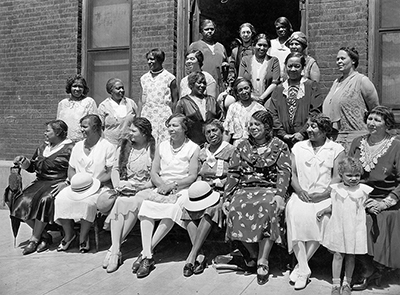
The Montana Federation of Colored Women's Clubs was founded, joining together ten organizations. (Montana Federation of Colored Women's Clubs, Montana Federation of Colored Women'due south Clubs records, 1921-1978, MC 281, MHS).
Henry Bakery was named postmaster at the state Capitol; he was believed to exist the kickoff Montana country official of African American descent. ( Anaconda Standard, July iii, 1921).
The Ku Klux Klan (KKK) organized in Montana. Though it counted approximately five,100 members at its pinnacle, evidence suggests that Montana's KKK held trivial influence over the lives of black Montanans, as the organization's anti-Catholic/anti-immigrant stance outweighed whatsoever anti-black attitudes were found in the state. ( Christine K. Erickson, " 'Kluxer Blues': The Klan Confronts Catholics in Butte, Montana, 1923-1929," Montana: the Magazine of Western History , Spring 2003, pp. 44-57.)
1922
Governor Joseph M. Dixon delivered a welcome address to the second annual convention of the Montana Country Federation of Negro Women's Clubs in Helena.
James Dorsey, son of 25th Infantry veteran Ephram Dorsey, grew upwards in Missoula and graduated from the Academy of Montana in 1922. He was the first African American to matriculate from that institution. Five years later on he earned a degree from the Academy of Montana Law School. Dorsey expert law in Milwaukee for nearly 40 years & received a Distinguished Service Honour from his alma mater in 1963. (Run into MHS Photo Archives photo # 951-484.)
1927
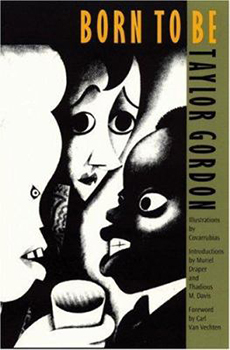
Tenor Taylor Gordon, a White Sulphur Springs native, sang spirituals with baritone/pianist J. Rosamond Johnson at Carnegie Hall. He later on wrote a acknowledged memoir, Born to Exist (1929), detailing his Montana adolescence, participation in the Harlem Renaissance, and advancing critical appreciation of the spiritual as an fine art form. ( New York Times, February 17, 1927.)
1930
Of the 537,606 people the census listed in Montana, 1,256 were African Americans.
Almost 25% of Montanans received some sort of regime aid.
"Colored Walsh for Senator Society" held a rally in Helena for "members & sympathizers" advocating white U.Southward. Senator Thomas J. Walsh's re-election. ( Helena Contained, Nov 2, 1930, p. 6.)
1933
New Bargain programs began beyond the state, including Montana.
Going to the Lord's day Route opened in Glacier National Park.
Almost 1,000 African Americans came to Montana to piece of work in the Kootenai National Forest as function of the Civilian Conservation Corps (CCC). Concerns at the local and national levels over integrated CCC camps led to their difference in 1934. (Dwayne Mack, "May the Work I've Done Speak for Me: African American Civilian Corps (sic) Enrollees in Montana, 1933-1934," Western Periodical of Blackness Studies 27, November 2003, pp. 236-245.)
1934
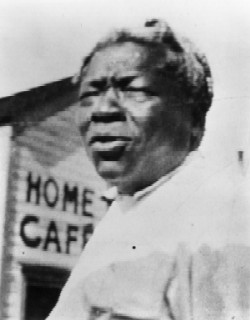
Alice Pleasant, aka Ma Plaz, passed away in Havre. Born in 1850 to parents who were slaves, she lived in Louisiana and Texas before arriving in Montana. Starting time in the 1890s, Pleasant operated a restaurant in the Montana National Banking concern in Havre. She gained fame for her craven dinners, quick wit, and generosity. ( Hill County Periodical, August xvi, 1934; Hill Canton Bicentennial Commission, Grit, Guts and Gusto: A History of Loma County , (Havre, Hill County, Mont: Loma Canton Bicentennial Commission, 1976) pp. 306-307.)
1935
African American Naseby Rhinehart accustomed a position as athletic trainer for the University of Montana, a position he held for xl-7 years. A pioneer in developing coursework for able-bodied trainers, he passed away in 1991. ( Great Falls Tribune, June 12, 1991.)
The Butte Colored Giants baseball squad won the championship for the kickoff half of the Montana Country Baseball League'southward separate season.
1937
A Montana legislative committee considered a civil rights neb "relating to the discrimination betwixt citizens in regard to sure services and employment," simply it did not pass. The Dunbar Fine art and Written report Club of Butte, an African American women's organization, helped lobby for its passage. (Montana Federation of Colored Women's Clubs, Montana Federation of Colored Women's Clubs records, 1921-1978, MC 281, MHS.)
1939
Nazi Deutschland invaded Poland.
Daughters of the American Revolution prohibited contralto Marian Anderson from singing at Constitution Hall in Washington, D.C. She performed at the Lincoln Memorial instead.
1940:
Between 1940 and 1943, Montana'south population dropped by 16%.
1,120 African Americans counted as living in Montana in the 1940 census. (559,456 total population).
1941
The states declared state of war on Japan after it bombed Pearl Harbor; Montanan Jeanette Rankin cast the sole vote in Congress against the declaration.
Anaconda newspaper reporter Edward B. Reynolds contributed essays on smelter work to the WPA anthology Men at Piece of work; his older brother Rox Reynolds, as well a journalist, was a well-known humor essayist for Seattle & San Francisco newspapers.
1942
Malmstrom Air Forcefulness Base of operations was built near Great Falls. Information technology became a conduit for African American migration to Montana. (Malmstrom Air Force Base, vertical files, Montana Historical Society.)
In order to aid meet the war effort's copper quotas, the U.S. armed forces furloughed a battalion of Southern black miner-soldiers to Butte. 8,000 white Butte miners subsequently walked out citing safety issues even though the black soldiers were experienced miners. (Matthew L. Basso, Run across Joe Copper: Masculinity and Race on Montana's Globe War Ii Home Front end, Chapter half-dozen: "Butte, 1942: White Men, Black Soldier-Miners and the Limits of Popular Front Interracialism," (Chicago: Academy of Chicago Printing, 2003), pp. 159-194.)
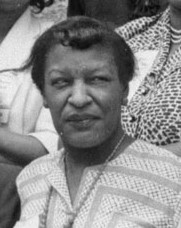
Helena native and registered nurse Octavia Bridgwater enlisted in the Army Nurse Corps. She was one of just several hundred blackness nurses permitted to serve in the segregated armed forces, and attained the rank of First Lieutenant. (Ellen Baumler, Kate Hampton, and John Boughton, "Haight-Bridgwater House National Register of Historic Places Registration Grade," (Helena, Mont.: MT Historical Social club, 2014).)
1950
The U.South. entered the Korean War.
Of the 591,024 people living in Montana, 1,232 were African American.
1953
Cascade County Community Council appointed an "Interracial Committee" to study the thing of racial discrimination. Of detail business concern was the treatment of the black airmen at Malmstrom Air Force Base and their comprisal to establishments in the urban center. (Montana Federation of Colored Women's Clubs, Montana Federation of Colored Women's Clubs records, 1921-1978, MC 281, MHS.)
The Montana Federation of Colored Women's Clubs likewise pushed for passage of House Pecker 73, "An human action to guarantee the full and equal enjoyment of all places of public accommodation and amusement; and repealing all acts and parts of acts in conflict herewith." Critics assailed the measure, proposed by the Smashing Falls legislative delegation, as "a police confronting whites," claiming it would pb to an increase in the African American population, and subsequent loss of property values. Other legislators feared extending the use of public accommodations to Native Americans. The measure did non pass. More successful was a measure to end miscegenation laws. House Nib 8 passed on Feb 2, and repealed laws that forbade spousal relationship between whites and blacks or whites and Asians. The miscegenation laws were originally passed in 1909. (Montana Federation of Colored Women's Clubs records, MC 281, MHS; Great Falls Leader, February 11, 1953; Laws, Resolutions, and Memorials of the State of Montana, 1909 , Chapter 49, pg. 57; Laws Resolutions, and Memorials of the Country of Montana, 1953, Chapter iv; Miscegenation, vertical files, MHS.)
Butte's black women'south guild, the Pearl Society, hosted contralto Marian Anderson. Over two,000 attended her concert at the city'due south Civic Centre.
Afterward lx years, Julian Anderson retired from his bartender post at the Montana Club, a private men's guild in downtown Helena. ( Helena Independent Record, July 12, 1964, p. 43.)
1954
Supreme Court outlawed school segregation with Brown v. Topeka Lath of Teaching decision.
Excavation began on what became the Berkeley Pit in Butte.
1960
African Americans deemed for ane,467 of 674,767 living in Montana.
1961
Russ Williams, a popular senior at Helena High Schoolhouse, died from an adventitious shooting. Williams, an African American, had been senior class president, a member of the National Honor Lodge, and chosen by the faculty to be a member of the schools "3-7-77" honorary service club. ( Helena Contained Tape, January 25, 1961, p. 11.)
1962
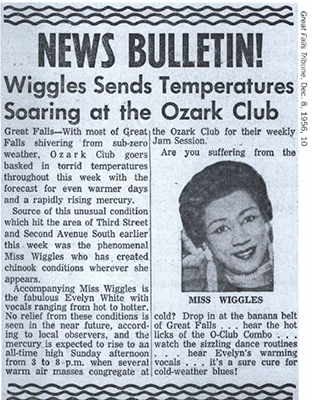
Neat Falls' Ozark Club, "where all were welcome," burned down. Owned for many years past a former boxer, African American Leo LaMar, it was a place dear for its live music, exotic dancing, and interracial crowd. Other noted black-owned clubs in Montana's history included Helena'south Zanzibar Lodge, Butte's Argent City Guild, and Missoula'due south Hawthorne Club. (Ken Robison, "Breaking Racial Barriers: 'Anybody's Welcome' at the Ozark Club Great Falls, Montana's African American Nightclub," Montana: The Magazine of Western History, Vol. 62, No. 2 (Summer 2012), pp. 44-58, 94-95; Keen Falls Tribune, February 5, 2006.)
1964
Senate Majority leader Mike Mansfield of Montana helped laissez passer the Civil Rights Act. ( Don Oberdorfer , Senator Mansfield: The Boggling Life of a Bully American Statesman and Diplomat , Part 9: "Johnson I: Years of Escalation, Civil Rights Human action of 1964,"(Washington, D.C.: Smithsonian Institution, 2015.)
1965
In response to the attack on ceremonious rights marchers in Selma, Alabama, marches in support of civil rights took place in Missoula and Billings. ( Missoulian, March 18-nineteen, 21, 1965; Billings Gazette, March fifteen-16, 1965.)
1968
Daniel P. Brockman became the first African American admitted to the Montana Veterans' Home in Columbia Falls. His father had worked all over the Due west before arriving in Montana, farming in Dawson and Beaverhead counties; he obtained a homestead patent in the latter at the age of 78. The younger Brockman served in both World Wars, earning the Croix de Guerre in World State of war I. A life member of the Twin Bridges American Legion Post, he lived most of his life in Madison Canton, working as a ranch hand. He passed away in 1972. ( Hungry Equus caballus News, December 20, 1968, February 15, 1972; Bureau of the Census population schedules, 1870, 1880, 1910.)
1970
The Census revealed one,995 African Americans living in Montana out of a total of 694,409.
1972
Montanans approved a new state constitution.
1973
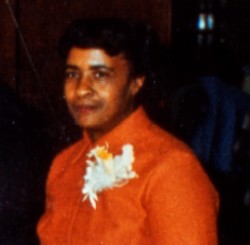
African American Alma Jacobs appointed State Librarian, a post she held until 1981. Before that she served every bit manager of the Great Falls Library; during her tenure in that position she was instrumental in getting a new building for that establishment in 1967. Born in Lewistown in 1916, she passed away in 1997. "I think a person, whether he is Negro or whatever, is entitled to his own life, without beingness dumped into a grouping with predetermined characteristics." (Alma Smith Jacobs, vertical file, MHS.)
1974
Geraldine Travis of Firm District 43 (Great Falls) became the kickoff African American elected to the Montana legislature. She served one term. ( Swell Falls Tribune, Jan 12, 1975, Nov 4, 1976.)
1980
Census revealed 786,690 people living in Montana; ane,786 were African American.
The Atlantic Richfield Visitor (ARCO) closed their smelting and refining operations in Slap-up Falls and Anaconda; three years after information technology ended mining in Butte (though it was later on resumed on a small-scale ground).
1990
Montana's population counted as 799,065, out of which 2,381 were African American.
1991
Montana became the forty-eighth state to declare an official holiday in award of Martin Luther Rex. ( Helena Independent Record, February 9, 1991.)
1992
The Great Falls chapter of the NAACP hosted a rally on the steps of the Civic Center to protestation both the verdict of the Rodney King trial and the riots in Los Angeles that followed. ( Swell Falls Tribune , May 4, 1992.)
2000
Of the 902,195 listed as living in Montana in the decennial census, 4,441 claimed at least some African American heritage, including two,692 who identified solely as African American.
2010
Of the 989,415 listed equally living in Montana, 7,917 claimed at least some African American heritage, including four,027 identified solely equally African American.
Source: https://mhs.mt.gov/Shpo/AfricanAmericans/History/Timeline
Posted by: sandovalventing.blogspot.com
0 Response to "What Was The Ethnic Makeup Of Montana In The 1900's"
Post a Comment